SEO for Beginners: Your Ultimate Guide to Getting Found on Google
You’ve done it. You’ve poured your heart, soul, and savings into creating a beautiful website for your business. It’s launched, it’s live, and it’s… silent. Crickets. You check your analytics, and the only visitor is you (and maybe your mom). Sound familiar?
That feeling of having a billboard in the middle of a desert is frustrating. You have an incredible product or service, but if no one can find you online, does it even exist? This is the exact problem that sends countless freelancers and small business owners into a panic.
But what if I told you there’s a way to turn that deserted digital space into a bustling hub of activity? What if you could create a digital roadmap that leads your ideal customers directly to your front door, 24/7, for free? That roadmap is Search Engine Optimization (SEO).
This isn’t some dark art reserved for tech wizards. This is a practical, learnable skill. In this comprehensive SEO for beginners guide, we’ll break down everything you need to know—from how search engines work to the exact steps you can take today to start climbing the ranks and attracting the traffic your business deserves.
What is SEO, Really? Demystifying the Magic

Let’s cut through the jargon. Search Engine Optimization (SEO) is the practice of improving your website to increase its visibility when people search for products or services related to your business in Google, Bing, and other search engines.
Think of Google as a massive library and every website as a book. SEO is how you tell the librarian (Google) that your book is the most relevant, trustworthy, and helpful resource for a specific topic. The better you optimize your “book,” the higher the librarian will place it on the shelf for everyone to see.
The key word here is organic. This means you’re not paying for ads (like in Search Engine Marketing, or SEM). You’re earning your spot at the top through quality and relevance.
Why Should You, a Busy Entrepreneur, Care About SEO?
You’re juggling a million things. Is learning SEO really worth your time? In a word: absolutely.
Organic search is the king of website traffic. In fact, a study by BrightEdge revealed that organic search drives 53.3% of all website traffic, making it the largest digital channel by a huge margin. Paid search? Just 15%.
Here’s why it matters for you:
- Credibility and Trust: People inherently trust organic results more than paid ads. Ranking high on Google positions you as an authority in your field.
- High-Quality Traffic: With SEO, you’re not shouting into the void. You’re attracting people who are actively searching for the solutions you provide. They are warm leads, ready to engage.
- Sustainable, Long-Term Results: A paid ad stops working the second you stop paying. A well-ranked article can bring you traffic, leads, and sales for years to come. It’s the gift that keeps on giving.
- Cost-Effective Marketing: While it requires an investment of time (or money, if you hire help), SEO provides one of the best ROIs in digital marketing.
SEO isn’t just about traffic; it’s about building a sustainable, long-term asset for your business.
How Do Search Engines Actually Work? A Simple 3-Step Process
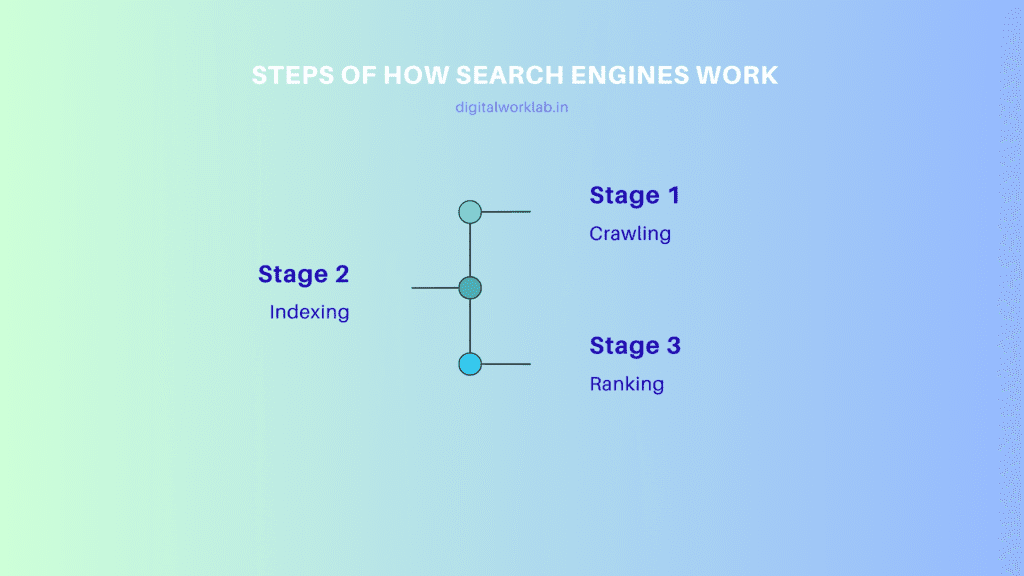
To win the game, you need to know the rules. Search engines like Google have one primary goal: to provide the user with the best possible answer to their query. They do this through a complex process that can be simplified into three main steps.
Step 1: Crawling
Google sends out an army of little robots, called “crawlers” or “spiders,” to travel the web 24/7. They follow links from one page to another to discover new and updated content. It’s like they’re exploring a giant spiderweb of interconnected pages.
Step 2: Indexing
Once a crawler finds a page, it tries to understand what the page is about. It analyzes the content, images, and video files on the page and stores this information in a massive database called the index. Think of this as the library’s catalog. If your site isn’t in the index, it’s invisible to searchers.
Step 3: Ranking
This is the magic moment. When someone types a search query, Google scours its index for the most relevant results. It then uses its complex algorithm—which considers hundreds of factors—to rank those pages from most to least relevant. This is what creates the search engine results page (SERP) you see. Your goal with SEO is to convince Google that your page deserves to be at the top of that list.
The Three Pillars of SEO: Your Foundation for Success
Feeling overwhelmed? Don’t be. The hundreds of ranking factors can be neatly organized into three core categories. This is the basic SEO guide you need. Master these three “pillars,” and you’ll be well on your way.
Pillar 1: On-Page SEO (The Content You Control)
On-page SEO includes everything you do on your website to make it clear to both search engines and users what your content is about. This is the pillar you have the most direct control over.
Key elements of on-page SEO include:
- High-Quality Content: Creating content that is helpful, comprehensive, and answers the user’s search query better than anyone else. This is the #1 factor.
- Keyword Optimization: Strategically using your target keywords in your titles, headings, content, and image alt text.
- Title Tags & Meta Descriptions: Crafting compelling, clickable titles and descriptions that show up on the SERP.
- Header Tags (H1, H2, H3): Using headers to structure your content logically, making it easier for both readers and crawlers to understand.
- Internal Linking: Linking to other relevant pages on your own website to help crawlers discover more of your content and distribute authority.
Pillar 2: Off-Page SEO (Building Your Reputation)
Off-page SEO refers to actions taken outside of your own website to impact your rankings. This is largely about building your website’s authority and reputation.
The most crucial element of off-page SEO is backlinks.
A backlink is a link from another website to yours. Google views backlinks as votes of confidence. If a reputable, high-authority website links to you, it’s like they’re vouching for your content. The more high-quality backlinks you have, the more trustworthy your site appears to Google.
“Think of a backlink as a recommendation. The more credible the source of the recommendation, the more weight it carries.”
Other off-page strategies include guest blogging, social media marketing, and being mentioned in online forums or publications.
Pillar 3: Technical SEO (The Engine Under the Hood)
Technical SEO has nothing to do with the content itself, but with the configuration of your website. It ensures that search engines can crawl and index your site without any issues. It’s the foundation that your on-page and off-page efforts are built upon.
Key elements of technical SEO include:
- Site Speed: How fast your pages load. Slow sites frustrate users and are penalized by Google.
- Mobile-Friendliness: Your site must look and work great on mobile devices, as a majority of searches now happen on phones.
- Site Architecture: Having a logical, easy-to-navigate site structure.
- XML Sitemap: A file that lists all your important pages, making it easier for Google to find them.
- Security (HTTPS): Ensuring your site is secure with an SSL certificate.
The Pillars of SEO: A Quick Comparison
| Feature | On-Page SEO | Off-Page SEO | Technical SEO |
| Primary Goal | Make content relevant and high-quality. | Build authority and trust. | Ensure the site is crawlable and fast. |
| Key Elements | Keywords, content, titles, headers. | Backlinks, brand mentions, social signals. | Site speed, mobile-friendliness, security. |
| Where it’s Done | Directly on your website’s pages. | On other websites and platforms. | In your website’s backend and server setup. |
| Example Task | Writing a blog post targeting a keyword. | Earning a link from an industry blog. | Compressing images to improve page speed. |
Export to Sheets
Your First Mission: Keyword Research for Beginners
Everything in SEO starts with keywords. You can’t create optimized content if you don’t know what terms your audience is searching for. Keyword research is the process of finding these terms.
Your goal is to find keywords that have:
- Good Search Volume: A decent number of people are searching for it.
- High Relevance: The keyword is directly related to your business offerings.
- Achievable Difficulty: You have a realistic chance of ranking for it against the competition.
So, how do you find them?
- Brainstorm: Start by listing all the topics related to your business. Think like your customer. What words would they use to find you?
- Use Google: Type your brainstormed ideas into Google and look at the “People Also Ask” and “Related Searches” sections. These are pure gold.
- Use a Free Tool: Use a tool like the Ahrefs Free Keyword Generator to get ideas and see estimated search volumes. Simply enter a seed topic, and it will give you a list of related keywords.
Focus on long-tail keywords. These are longer, more specific phrases (e.g., “best seo tools for small business owners” instead of just “seo tools”). They have lower search volume but much higher intent, meaning the searcher is closer to making a decision.
Top SEO Tools for Small Business Owners on a Budget
While you can do a lot manually, a few tools can make your life much easier. Here are some beginner-friendly options:
- Google Analytics: Absolutely essential and 100% free. It tells you everything about your website traffic: who is visiting, how they found you, and what they do on your site.
- Google Search Console: Another free, non-negotiable tool from Google. It helps you monitor your site’s performance in search, submit sitemaps, and find technical errors.
- Ubersuggest: A freemium tool from Neil Patel that’s great for keyword research, competitor analysis, and site audits. The free version is quite generous.
- Rank Math / Yoast SEO: If you’re on WordPress, one of these plugins is a must-have. They guide you through on-page SEO best practices right from your editor.
[Video of a brief tutorial on using Google Search Console]
Frequently Asked Questions (FAQs)
1. Can I do SEO on my own?
Yes, absolutely! Especially when you’re just starting out. The basics of SEO—creating quality content, using keywords, and ensuring your site is mobile-friendly—are all things you can learn and implement yourself.
2. How long does it take for SEO to work?
SEO is a marathon, not a sprint. You likely won’t see significant results overnight. Generally, you can expect to see noticeable movement in 4 to 6 months, with more substantial results taking up to a year. It depends on your industry, competition, and the consistency of your efforts.
3. What are the 3 main pillars of SEO?
The three main pillars are On-Page SEO (optimizing your content), Off-Page SEO (building authority with backlinks), and Technical SEO (improving your site’s backend and performance).
4. Is SEO difficult to learn?
The fundamentals of SEO are not difficult to learn. The real challenge is in the consistent application and staying updated, as search engine algorithms change. But anyone can master the basics laid out in this guide.
5. What is the first step in SEO?
The very first step is keyword research. Before you do anything else, you must understand what your target audience is searching for. This knowledge will guide your entire content and optimization strategy.
6. How much does SEO cost for a beginner?
If you do it yourself, the only cost is your time and potentially a few budget-friendly tools (many of which have free versions). If you hire a freelancer or agency, costs can range from a few hundred to several thousand dollars per month, depending on the scope of work.
Your SEO Journey Starts Now
We’ve covered a lot, from understanding what SEO is to the three core pillars and your first steps in keyword research. It might seem like a mountain to climb, but remember: every expert was once a beginner.
Don’t try to do everything at once. The journey of a thousand miles begins with a single step. For you, that first step is simple.
Your Action Plan:
- Set up Google Analytics and Google Search Console. This is non-negotiable.
- Perform your first round of keyword research. Identify 5-10 long-tail keywords you want to target.
- Audit one of your existing pages. Can you improve the title? Add more helpful content? Add some internal links?
By focusing on providing real value to your audience, you’re already aligning with Google’s main goal. Start small, be consistent, and watch as your digital ghost town transforms into a thriving online destination. You’ve got this.


Post Comment
You must be logged in to post a comment.